Tell us about the job
Takes about a minute. No obligation.
A contractor quoting a water heater installation in Dawson County is not working in a high-weather-load environment. 58 severe weather events were recorded in Dawson County, Georgia between 2015 and 2024. At that rate, severe weather is an occasional event rather than a standing condition, which means it seldom accounts for what a unit has been through. Age, venting quality, and how the original unit was sized for the home are the variables that shape what a contractor specifies and how they price the job.
Older electrical panels are where water heater installations in this county run into friction. Half the homes in Dawson County, Georgia were built in 1999 or earlier (2020-2024 ACS 5-year). A house wired in that era was sized for equipment of that era, and a modern water heater, particularly a heat pump unit, can draw more than the existing service was laid out to handle. A licensed contractor will open the panel and measure before pricing anything else, because the gap between what the house has and what the new equipment needs determines whether the install is straightforward or whether the electrical has to come first.
The Parts of a Water Heater an Installer Works With
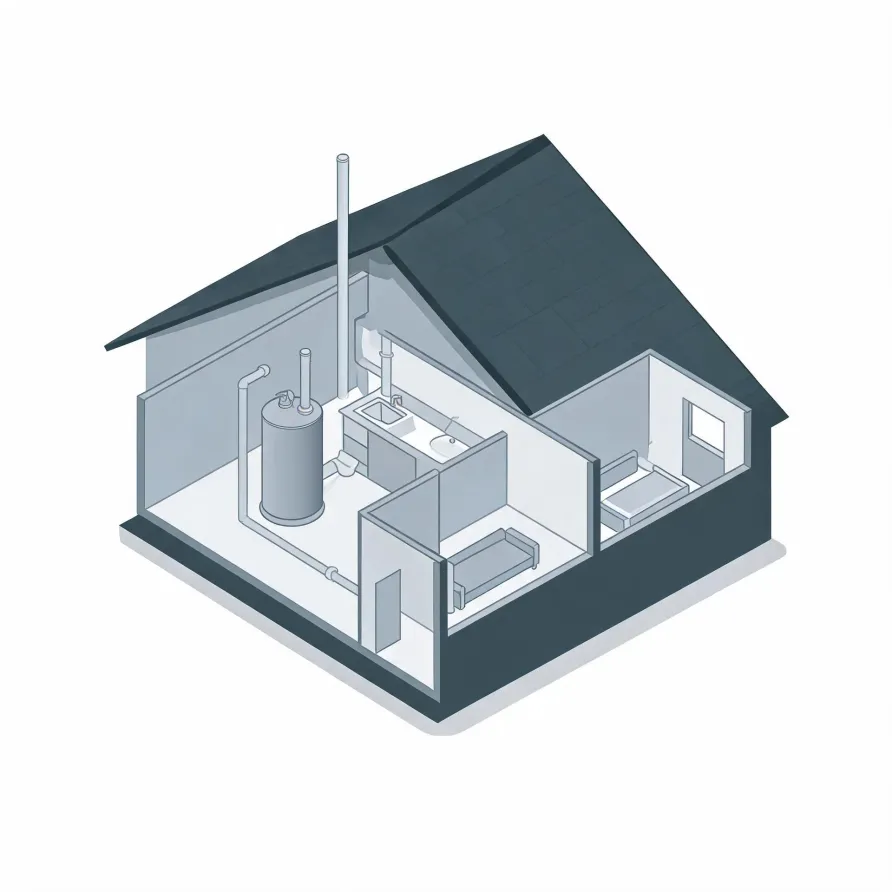
The storage tank is the centerpiece of the system, sitting in a utility room, basement, or closet, and its job is to hold a ready supply of hot water for the house. Attached to the tank is the burner assembly or heating element, depending on fuel type, which sits at the base or inside the tank and is what actually raises the water temperature.
The pressure relief valve mounts directly on the tank and releases if internal pressure climbs too high. A cold-water inlet and a hot-water outlet connect the tank to the home's plumbing lines, and an anode rod runs down through the tank interior to slow corrosion of the tank walls.
The drawing shows a typical layout, and a licensed contractor determines what fits the conditions in your specific home.
Get matched in Dawson CountyDawson County, by the numbers
58 severe weather events were recorded in Dawson County, Georgia between 2015 and 2024.
NOAA National Centers for Environmental Information, Storm Events Database, bulk CSV export, events 2015-01-01 through 2024-12-31.Half the homes in Dawson County, Georgia were built in 1999 or earlier (2020-2024 ACS 5-year).
U.S. Census Bureau, 2020-2024 American Community Survey 5-Year EstimatesDawson County, Georgia holds 12,992 housing units (2020-2024 ACS 5-year).
U.S. Census Bureau, 2020-2024 American Community Survey 5-Year EstimatesOwners occupy 78.7% of the occupied homes in Dawson County, Georgia (2020-2024 ACS 5-year).
U.S. Census Bureau, 2020-2024 American Community Survey 5-Year EstimatesSevere Weather Events in Dawson County
Water heaters work harder when outdoor conditions swing hard, and Dawson County's weather shapes the real-world load a unit carries year after year. Knowing the local pattern helps a contractor size and install equipment that holds up to what this area actually delivers.
58 severe weather events, 2015–2024. Source: NOAA National Centers for Environmental Information, Storm Events Database.