Tell us about the job
Takes about a minute. No obligation.
A water heater repair in Jones County starts with the unit itself, not with what the sky has done. 35 severe weather events were recorded in Jones County, Georgia between 2015 and 2024. At that rate, severe weather is an event here, not a constant condition bearing down on every system year-round. A contractor arriving at a failing unit will check the anode rod, the heating elements, and how the original installation was handled, because those are what give out in this county. Weather is worth a look, but age and maintenance gaps are what write the repair order.
Water heaters installed in houses this old have often outlasted the original plumbing fittings around them, and what a contractor finds once a unit comes apart reflects that. Half the homes in Jones County, Georgia were built in 1991 or earlier (2020-2024 ACS 5-year). A water heater that has been cycling in a house of this vintage tends to show mineral accumulation at the drain valve, stress at the inlet and outlet connections, and flue deterioration if it is a gas unit. Those are the conditions that shape the repair scope, and they do not show up on the outside.
The Parts of a Water Heater a Contractor Checks During a Repair
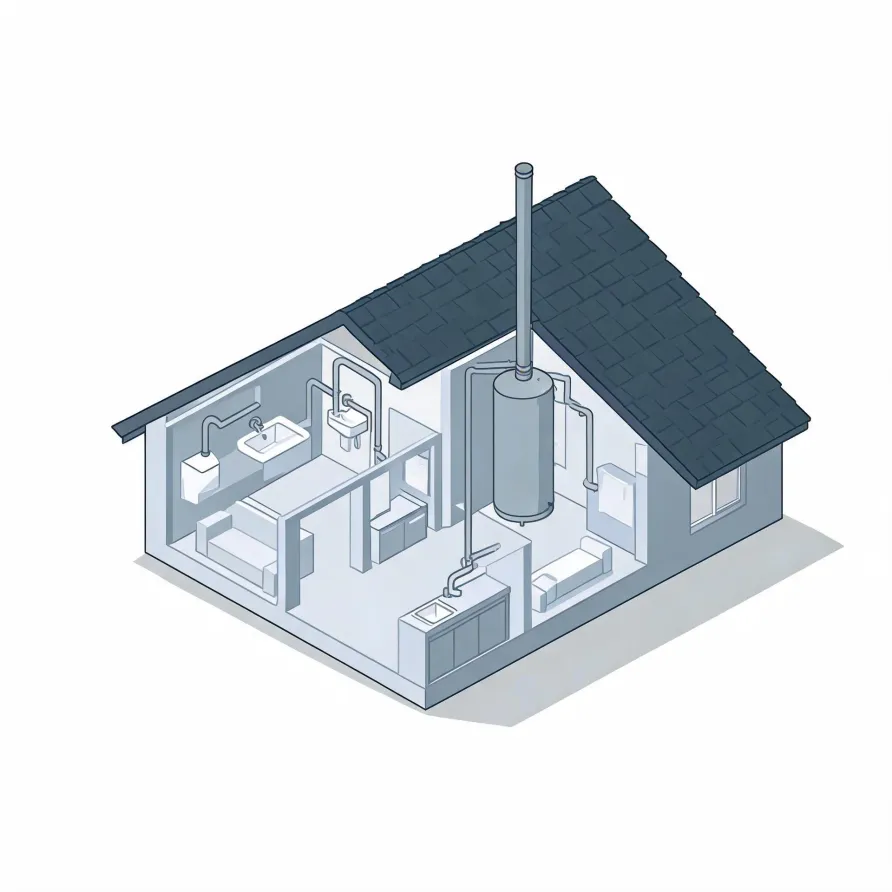
The tank is the piece a homeowner notices first, sitting in a utility closet, basement, or garage, and its job is to hold and heat a supply of water ready for use. The burner assembly or heating element sits at the base or inside the tank and is where a contractor looks when water comes out cold or only lukewarm.
The thermostat controls when the heating element or burner fires, and a faulty one is a common source of temperature problems. The pressure relief valve mounts on the side of the tank as a safety device, while the anode rod runs inside the tank to slow corrosion. Both get examined when a repair call involves leaking, rumbling, or rust-colored water.
The drawing shows a general layout of these components, and a licensed contractor determines which parts apply to the specific unit and setup in your home.
Get matched in Jones CountyJones County, Georgia, by the numbers
35 severe weather events were recorded in Jones County, Georgia between 2015 and 2024.
NOAA National Centers for Environmental Information, Storm Events Database, bulk CSV export, events 2015-01-01 through 2024-12-31.Half the homes in Jones County, Georgia were built in 1991 or earlier (2020-2024 ACS 5-year).
U.S. Census Bureau, 2020-2024 American Community Survey 5-Year EstimatesJones County, Georgia holds 11,872 housing units (2020-2024 ACS 5-year).
U.S. Census Bureau, 2020-2024 American Community Survey 5-Year EstimatesOwners occupy 83.6% of the occupied homes in Jones County, Georgia (2020-2024 ACS 5-year).
U.S. Census Bureau, 2020-2024 American Community Survey 5-Year EstimatesSevere Weather Events in Jones County
Extreme weather puts real stress on water heaters, forcing equipment to work harder and wear faster than it would under steady conditions. How often that happens here shapes how much repair work local units actually need.
35 severe weather events, 2015–2024. Source: NOAA National Centers for Environmental Information, Storm Events Database.